"...when the last individual
of a race of living things breathes no more, another Heaven and another
Earth must pass before such a one can be again."
-William Beebe
 • SEARCH ALBC
Bronze Turkey
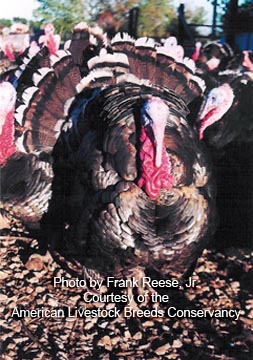 The
Bronze has been the most popular turkey variety for most of American history.
It originated from crosses between the domestic turkeys brought by European
colonists to the Americas and the eastern wild turkeys they found upon
their arrival. The hybrid vigor of this cross resulted in turkey stocks
that were larger and more vigorous than the European birds, and they were
also much tamer than wild turkeys. The coppery-bronze colored metallic
sheen, which gives the variety its name, was part of the inheritance from
its wild ancestors.
The
Bronze has been the most popular turkey variety for most of American history.
It originated from crosses between the domestic turkeys brought by European
colonists to the Americas and the eastern wild turkeys they found upon
their arrival. The hybrid vigor of this cross resulted in turkey stocks
that were larger and more vigorous than the European birds, and they were
also much tamer than wild turkeys. The coppery-bronze colored metallic
sheen, which gives the variety its name, was part of the inheritance from
its wild ancestors.
Bronze-type turkeys were known by the late 1700s, but the name “Bronze” did not formally appear until the 1830s. Throughout the 1800s, breeders standardized the Bronze, and occasional crosses were made back to the wild turkey. The Bronze variety was recognized by the American Poultry Association in 1874.
The status of this variety has changed dramatically during the past century. In the early 1900s, a broader breasted Bronze turkey was introduced from England into Canada, and then into the northwestern United States. These were crossed with larger, faster growing US stocks and the resulting bird, the Broad Breasted Bronze, became the commercial variety of choice. Further selection improved meat production, especially that of breast meat, growth rate, and other performance qualities. At the same time, changes in conformation (especially the shortening of the legs and the keel) nearly eliminated their ability to mate naturally. For this reason, most Broad Breasted Bronze turkeys have been artificially inseminated since the 1960s. Beginning in the 1960s the Broad Breasted Bronze was replaced by the Broad Breasted White turkey. Processors favored the white-feathered variety because it produced a cleaner looking carcass. Today, the Broad Breasted Bronze is no longer used by the turkey industry, but it is promoted for seasonal, small-scale production.
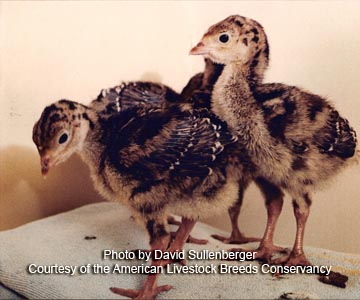 Naturally
mating, long-lived, slow growing strains of Bronze turkeys, known as the
Standard Bronze, have been left even further behind by the turkey industry.
A few tenacious breeders maintained small flocks, participating in poultry
shows, and raising a few for family and friends. The Bronze was not used
for commercial production for decades until the early 21st century, when
renewed interest in the biological fitness, survivability, and superior
flavor captured consumer interest and created a growing market niche.
Naturally
mating, long-lived, slow growing strains of Bronze turkeys, known as the
Standard Bronze, have been left even further behind by the turkey industry.
A few tenacious breeders maintained small flocks, participating in poultry
shows, and raising a few for family and friends. The Bronze was not used
for commercial production for decades until the early 21st century, when
renewed interest in the biological fitness, survivability, and superior
flavor captured consumer interest and created a growing market niche.
The Bronze variety is stately and imposing in appearance. The standard weight for young toms is 25 pounds and for young hens is 16 pounds. Since, however, the Standard Bronze has not been selected for production attributes, including weight gain, for years, many birds may be smaller than the standard. Careful selection for good health, ability to mate naturally, and production attributes will return this variety to its former stature. Broad Breasted Bronze turkeys are also in need of conservation. Only a few hatcheries maintain breeding flocks, and many of these are reducing their number. Marketing strategies need to be developed for each type that does not undermine the other.
Status: See CPL
| The American Livestock Breeds Conservancy | |
PO Box 477 |
ALBC is a trademark
of American Livestock Breeds Conservancy. |
Pittsboro, North Carolina 27312 USA |
|
Telephone: 919-542-5704 |
|
Fax: 919-545-0022 |
|
|
HOME About
ALBC Breed Information Calendar ALBC
Store |
|