"...when the last individual
of a race of living things breathes no more, another Heaven and another
Earth must pass before such a one can be again."
-William Beebe
 • SEARCH ALBC
Dexter Cattle
Dexter cattle are among the smallest of cattle breeds in the world, standing 40" tall and weighing 700–900 pounds. Though size is the breed’s most distinguishing characteristic, the Dexter is a useful and producti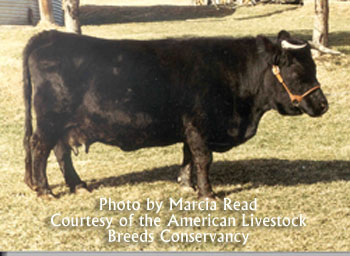 ve multi‑purpose animal.
The Dexter originated in southern Ireland during the early 1800s. It was developed from the Kerry, an Irish dairy breed, through selection for smaller size and improved beef qualities. The breed name came from a “Mr. Dexter,” who promoted the cattle during the mid‑1800s. The Dexter became popular with smallholders in Ireland and in England, who appreciated its efficiency in producing both milk and beef on limited acreage. Dexters were imported to North America beginning in 1910.
Even after the Dexter gained an identity as a breed, its history remained intertwined with that of the Kerry. For many years the two breeds were registered in a single herdbook, and some people considered Dexters to be a dwarf type of Kerry. Recent bloodtyping research, however, has determined that the Dexter and the Kerry, though closely related, are genetically distinct breeds. They should not be crossbred with each other.
Dexter cattle are solid and compact in appearance. Most Dexters are black, though red and dun are also found. The cattle are horned, and their black‑tipped white horns arc upward. Two body conformations are found within the breed: cattle with normal bodies and very short legs, and cattle which are proportionately small in every dimension. Because the short‑legged type occasionally produces nonviable offspring, it has fallen out of favor, while the proportionate type has become more popular.
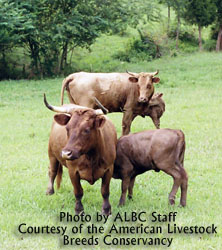 The Dexter has always attracted attention because of its size, and it has sometimes been marketed as a novelty or ornamental breed. This practice has obscured the breed’s production value. Dexters are hardy, forage‑efficient cattle with excellent maternal qualities. As with other dual‑purpose breeds, the quantity of milk produced varies between strains; those strains which have had more dairy selection produce more milk, while those which have been selected for beef produce less. The milk produced is high in solids, making it ideal for butter and cheese production. Dexter beef is lean and high in quality. The small size of the carcass makes the breed an excellent choice for use in direct marketing programs. Dexters are good browsers and can rid pastures of some pest plants, and they may also be used as oxen.
Dexter cattle are increasing in numbers in North America and globally, and the breed seems destined to succeed. The challenge facing breeders, however, is to maintain historic selection practices so that the Dexter’s production qualities are conserved and promoted.
Status: See CPL
Click Here for Breed Clubs and Association Contacts
| The American Livestock Breeds Conservancy | |
PO Box 477 |
ALBC is a trademark
of American Livestock Breeds Conservancy. |
Pittsboro, North Carolina 27312 USA |
|
Telephone: 919-542-5704 |
|
Fax: 919-545-0022 |
|
|
HOME About
ALBC Breed Information Calendar ALBC
Store |
|