"...when the last individual
of a race of living things breathes no more, another Heaven and another
Earth must pass before such a one can be again."
-William Beebe
 • SEARCH ALBC
Guinea Hog
 The
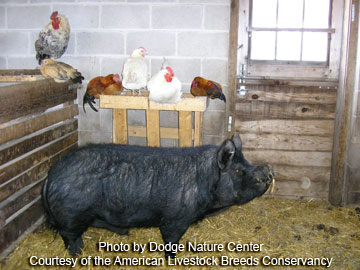
Guinea Hog is a small, black breed of swine that is unique to the United
States. Also known as the Pineywoods Guinea, Guinea Forest Hog, Acorn
Eater, and Yard Pig, the breed was once the most numerous pig breed found
on homesteads in the Southeast. Today there are fewer than 200.
The
Guinea Hog is a small, black breed of swine that is unique to the United
States. Also known as the Pineywoods Guinea, Guinea Forest Hog, Acorn
Eater, and Yard Pig, the breed was once the most numerous pig breed found
on homesteads in the Southeast. Today there are fewer than 200.
Hogs were imported from West Africa and the Canary Islands to America
in conjunction with the slave trade. The imports were documented as early
as 1804 by Thomas Jefferson and other Virginia farmers. These large, square
animals were called Red Guineas, because they had red or sandy colored
hair. Red Guineas were common throughout the mid-Atlantic region during
the 1800s. The breed disappeared as a distinct population in the 1880s,
when most of the red breeds and types of hogs in the eastern United States
were combined to form the new Jersey-Duroc breed. Although extremely rare,
occasionally Guinea hog breeders of today find red highlights in the hair
of their Guineas and even more rare, is a completely red individual born.
The name Guinea occurs again a few decades later in the southeastern
United States, though describing a different animal entirely – a
small, black hog common on homesteads across the region. Guinea Hogs were
expected to forage for their own food, eat rodents and other small animals,
grass, roots, and nuts, and clean out garden beds. The hogs were also
kept in the yard where they would eat snakes and thus create a safe zone
around the house. These Guineas were hardy and efficient, gaining well
on the roughest of forage and producing the hams, bacon, and lard essential
for subsistence farming.
Guinea Hogs were widespread, and descriptions of them varied. Generally,
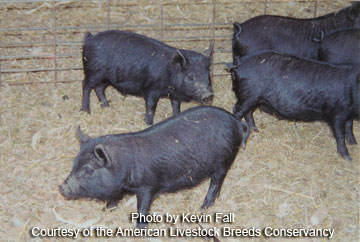
the hogs were small, weighing 100-300 pounds, and black or bluish-black
in color. They had upright ears, a hairy coat, and a curly tail. Beyond
this, conformation varied, as hogs could have short or long noses and
be “big boned,” “medium boned,” or “fine
boned.” It is likely that many strains of Guinea Hogs existed. Since
most of these are extinct, it is now impossible to weave together all
the threads of the Guinea Hog story into a single neat piece.
The Guinea Hog became rare in recent decades as the habitat of the homestead
hog disappeared, and it survived only in the most isolated parts of the
Southeast. During the 1980s, new herds of Guinea Hogs were established,
partly in response to the pet pig market.
 Several mysteries confuse the breed’s history. The relationship
between the historic Red Guinea and the Guinea Hog may be simply the common
use of the term “guinea” to refer to an African origin. “Guinea”
may also refer to the small size of the hogs, somewhat akin to the description
of miniature Florida Cracker and Pineywoods cattle as “guinea cows.”
The Guinea Hog may or may not be related to the Essex, a small, black
English breed which was imported to the United States in about 1820 and
used in the development of the Hampshire. Essex hogs were known to exist
in the Southeast until about 1900. The Essex hog’s history is obscure
and it eventually disappeared some time later that century. “Guinea
Essex” pigs were used in research at Texas A & M University
and at the Hormel Institute in the 1960s, though there is little information
-available about those stocks.
Several mysteries confuse the breed’s history. The relationship
between the historic Red Guinea and the Guinea Hog may be simply the common
use of the term “guinea” to refer to an African origin. “Guinea”
may also refer to the small size of the hogs, somewhat akin to the description
of miniature Florida Cracker and Pineywoods cattle as “guinea cows.”
The Guinea Hog may or may not be related to the Essex, a small, black
English breed which was imported to the United States in about 1820 and
used in the development of the Hampshire. Essex hogs were known to exist
in the Southeast until about 1900. The Essex hog’s history is obscure
and it eventually disappeared some time later that century. “Guinea
Essex” pigs were used in research at Texas A & M University
and at the Hormel Institute in the 1960s, though there is little information
-available about those stocks.
Though the Guinea Hog would greatly benefit from additional research and
description, it is clear that the breed is genetically distinct from improved
breeds of hogs and merits conservation. Like other traditional lard-type
breeds, however, the Guinea Hog faces great obstacles to its conservation.
These hogs do not produce a conventional market carcass, since they are
smaller and more fatty than is preferred today. Guinea Hogs are, however,
appropriate for use in diversified, sustainable agriculture. They would
be an- excellent choice where there is need for the services of hogs (such
as grazing, rooting, tilling compost and garden soil, and pest control)
and also the desire for a small breed. Under such husbandry, Guinea Hogs
would thrive, as they always have.
Status: See CPL
| The American Livestock Breeds Conservancy | |
PO Box 477 |
ALBC is a trademark
of American Livestock Breeds Conservancy. |
Pittsboro, North Carolina 27312 USA |
|
Telephone: 919-542-5704 |
|
Fax: 919-545-0022 |
|
|
HOME About
ALBC Breed Information Calendar ALBC
Store |
|