"...when the last individual
of a race of living things breathes no more, another Heaven and another
Earth must pass before such a one can be again."
-William Beebe
 • SEARCH ALBC
Hereford Hog
 The Hereford is a medium size hog breed that is unique to the United States.
It was developed in Iowa and Nebraska during the 1920s from -Duroc, Chester
White, and Poland China bloodlines. Additional breeding and selection
led to the identification of 100 animals as foundation stock in 1934,
and the National Hereford Hog Record was formed the same year to promote
the new breed. Within the first decade of its history, the association
attracted 450 members. Most of the interest in the Hereford breed was
found in Illinois, Iowa, and Indiana.
The Hereford is a medium size hog breed that is unique to the United States.
It was developed in Iowa and Nebraska during the 1920s from -Duroc, Chester
White, and Poland China bloodlines. Additional breeding and selection
led to the identification of 100 animals as foundation stock in 1934,
and the National Hereford Hog Record was formed the same year to promote
the new breed. Within the first decade of its history, the association
attracted 450 members. Most of the interest in the Hereford breed was
found in Illinois, Iowa, and Indiana.
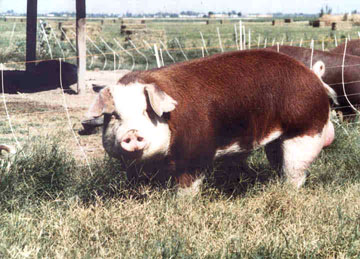
The Hereford’s name was inspired by its strikingly beautiful color
pattern of intense red with white trim, the same as that of Hereford cattle.
The breed description calls for hogs to be primarily red, with a white
face and two or more white feet. The shade of red can vary, though deep
red is preferred. Hereford cattlemen were so keen on the new breed of
swine that the Polled Hereford Cattle Registry Association sponsored the
formation of the National Hereford Hog Record.
Herefords are adaptable and thrive both in outdoor operations and under
confinement systems. They also do well in a wide variety of climates.
The hogs are known for their quiet and docile dispositions, making them
an excellent choice for young people. The breed is a-ppropriate for 4-H
projects because it combines market conformation with a strikingly attractive
appearance.
Breeders have emphasized early maturation, and Hereford hogs weigh 200-250
pounds by five to six months of age. Herefords are easy to pasture but
also grain-efficient, reaching market weight on less feed than many other
breeds. -Mature boars weigh about 800 pounds and -mature sows about 600
pounds. The sows produce and wean large litters. They make excellent mothers,
closely attentive to their bright red and white- -piglets.
The Hereford began to decline in numbers during the 1960s with the shift
away from the commercial use of purebred hogs and toward a three way cross
of the Duroc, Hampshire, and Yorkshire breeds. Today, the breed population
is estimated at fewer than 2,000 pigs in the United States, most of them
found in the upper Midwest and Plains states. The characteristics of the
Hereford, however, make it a natural choice for a -variety of small scale
production systems. If the breed is given opportunity under such systems,
it will be able to earn its place in the future.
Status: See CPL
Click Here for Breed Clubs and Association Contacts
photo: Hereford Boar. Photo by Mark Hess. All rights reserved.
| The American Livestock Breeds Conservancy | |
PO Box 477 |
ALBC is a trademark
of American Livestock Breeds Conservancy. |
Pittsboro, North Carolina 27312 USA |
|
Telephone: 919-542-5704 |
|
Fax: 919-545-0022 |
|
|
HOME About
ALBC Breed Information Calendar ALBC
Store |
|