"...when the last individual
of a race of living things breathes no more, another Heaven and another
Earth must pass before such a one can be again."
-William Beebe
 • SEARCH ALBC
Horses
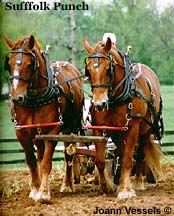
“A horse! A horse! My kingdom for a horse!” said King Richard III near the end of Shakespeare’s play about the ill-fated monarch. In the midst of a battle to save his throne, even the King himself was completely dependent upon a mount. Such was the historic value of the horse, giving power, speed, and mobility. Domestication of this species changed the course of human civilization.
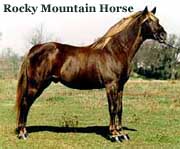 For
thousands of years, horses have been used in a wide array of environmentsÈ
Desire for aesthetics and style as well as utility shaped the development
of domestic horses and produced a range of breeds.
For
thousands of years, horses have been used in a wide array of environmentsÈ
Desire for aesthetics and style as well as utility shaped the development
of domestic horses and produced a range of breeds.
Spain and England were the primary sources of horses for North America. Horses from Spain were imported to the Americas beginning in the early 1500s, and Spanish horses were the dominant type in America for three centuries. Spanish genetics were integral to the development of North American gaited horse breeds and the stock horse breeds. Several pure Spanish breeds still exist in the Americas. They include the Spanish Mustang and Spanish Barb of North America and the Paso Fino, Peruvian Paso, and Criollo of Central and South America.
English horses were brought to North America beginning in the 1600s. The most famous and influential of the English imports was the Thoroughbred breed, which was developed in the mid-1700s and was brought to the United States shortly thereafter.
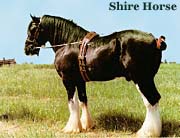 Two
breeds with origins in France have also made significant contributions
to horse breeding in North America. The Canadian horse, developed in Quebec
from French imports of the 1600s, was widely used in the improvement of
other stocks and in the development of new breeds. The Percheron, imported
in the 1800s, was once the most popular draft horse breed across the continent.
Two
breeds with origins in France have also made significant contributions
to horse breeding in North America. The Canadian horse, developed in Quebec
from French imports of the 1600s, was widely used in the improvement of
other stocks and in the development of new breeds. The Percheron, imported
in the 1800s, was once the most popular draft horse breed across the continent.
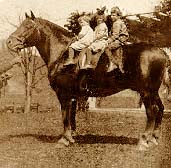
Horses, like cattle, had the economic value to justify the regular importation of purebred animals and to support pure breeding. Horse breeds and types continuously evolved to meet changing economic and social needs. The diversity of market demands acted to maintain a diversity of breeds. It was not until the mid-1900s that mechanization replaced horse power in agriculture and transportation. This eliminated the markets for many distinct breeds and caused them to decline.
 Sport
and recreation are now the primary areas of growth in the horse industry.
Selection within breeds has changed as well. Most riding horse breeds,
for example, have been selected according to the same criteria, leading
to a convergence of many breeds around the Thoroughbred/Quarter Horse
type. Crossbreeding has also been used extensively, and it has been accepted
as a quick and easy way to change a breed’s characteristics. Thus, most
breeds have come to look alike, and many are also related to each other
by pedigree.
Sport
and recreation are now the primary areas of growth in the horse industry.
Selection within breeds has changed as well. Most riding horse breeds,
for example, have been selected according to the same criteria, leading
to a convergence of many breeds around the Thoroughbred/Quarter Horse
type. Crossbreeding has also been used extensively, and it has been accepted
as a quick and easy way to change a breed’s characteristics. Thus, most
breeds have come to look alike, and many are also related to each other
by pedigree.
Relatively few distinct, pure breeds of horses remain, and their conservation should be a high priority for horse fanciers and the horse industry. Rare breeds of horses protect our genetic options for the future as well as the adaptability and utility of this valuable species.
Excerpted from A Rare Breeds Album of American Livestock, pg 47-48.
| The American Livestock Breeds Conservancy | |
PO Box 477 |
ALBC is a trademark
of American Livestock Breeds Conservancy. |
Pittsboro, North Carolina 27312 USA |
|
Telephone: 919-542-5704 |
|
Fax: 919-545-0022 |
|
|
HOME About
ALBC Breed Information Calendar ALBC
Store |
|