"...when the last individual
of a race of living things breathes no more, another Heaven and another
Earth must pass before such a one can be again."
-William Beebe
 • SEARCH ALBC
Jacob Sheep
 Sheep
with spots have been described in many cultures throughout history, appearing
in works of art from the Far East, Middle East, and Mediterranean regions.
Among these accounts is the Biblical story of Jacob, who bred spotted
sheep and for whom this breed is named.
Sheep
with spots have been described in many cultures throughout history, appearing
in works of art from the Far East, Middle East, and Mediterranean regions.
Among these accounts is the Biblical story of Jacob, who bred spotted
sheep and for whom this breed is named.
Spotted sheep were documented in England by the 1600s and were widespread by the mid-1700s. They became popular in England as ornamental, or "park" sheep. Jacobs were ideal for this role, as they were picturesque but required minimal care. Scant selection occurred for anything but hardiness, spots, and four horns. The result was a -primitive breed that looked after itself well.
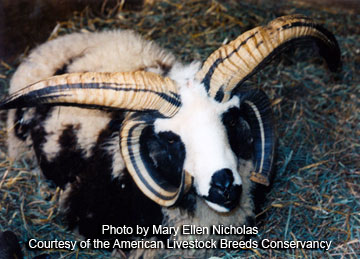
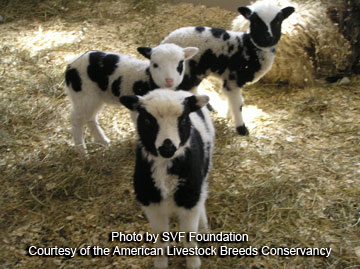
Jacobs are small, horned, black and white sheep. Ewes weigh 80-120 pounds, and rams 120-180 pounds. The sheep are white with colored spots or patches. The colored portions of the fleece are usually black, but they can also be brownish or a lighter color called lilac. The Jacob is a multi-horned or “polycerate” breed. Most animals have two or four horns, though six horns also occur. Both sexes are horned, and the rams can have horns of impressive size and shape.
The breed produces a medium fleece that is light and open, with a staple length of four to six inches and a weight of three to six pounds. Unlike most other medium wool breeds, quality of the fleece has been a major selection factor in the recent history of the Jacob breed. As a result, it is much sought after by fiber artisans, who enjoy its characteristics and color combinations – black, white, or a blend of the two.
 Jacob
sheep were first imported into North America beginning in the mid-1900s,
and most of today’s population descends from imports of the past
30 years. The breed has enjoyed widespread popularity among small flock
holders as well as handpsinners and weavers. -North American breeders
have selected primarily for fleece characteristics, and the conformation
of the sheep has remained very much like its historical description. Variability
is present, but this is -characteristic of an unimproved, primitive breed.
During the same period of time, the British Jacob has been selected for
greater commercial productivity, including larger size and more uniform
appearance. In this way, the populations in Britain and North America
have diverged. The American Livestock Breeds Conservancy has listed the
North American population of Jacobs as a conservation priority.
Jacob
sheep were first imported into North America beginning in the mid-1900s,
and most of today’s population descends from imports of the past
30 years. The breed has enjoyed widespread popularity among small flock
holders as well as handpsinners and weavers. -North American breeders
have selected primarily for fleece characteristics, and the conformation
of the sheep has remained very much like its historical description. Variability
is present, but this is -characteristic of an unimproved, primitive breed.
During the same period of time, the British Jacob has been selected for
greater commercial productivity, including larger size and more uniform
appearance. In this way, the populations in Britain and North America
have diverged. The American Livestock Breeds Conservancy has listed the
North American population of Jacobs as a conservation priority.
The distinctive appearance of the Jacob has sometimes worked in its favor but at other times has proven an obstacle to its conservation as a pure breed. Spotted sheep of all shapes and sizes, including spotted Jacob-Dorset and other crosses, have been sold as Jacobs to unsuspecting buyers. Identifying and recording the purebred Jacob population has been a continuing challenge for American breeders.
Status: See CPL
| The American Livestock Breeds Conservancy | |
PO Box 477 |
ALBC is a trademark
of American Livestock Breeds Conservancy. |
Pittsboro, North Carolina 27312 USA |
|
Telephone: 919-542-5704 |
|
Fax: 919-545-0022 |
|
|
HOME About
ALBC Breed Information Calendar ALBC
Store |
|