"...when the last individual
of a race of living things breathes no more, another Heaven and another
Earth must pass before such a one can be again."
-William Beebe
 • SEARCH ALBC
Rouen Duck
 “Among
the domestic ducks raised by French farmers several hundred years ago
were some resembling large Mallards. Around 1800, these ducks reached
England, where they were variously called “Rhone,” for an area in southwest
France, “Rohan,” for a Catholic Cardinal, “Roan,” a mixture of colors,
and finally “Rouen,” for a town in north central France.” (Holderread,
82). Once the Rouen arrived in England, breeders began to redesign the
bird through selective breeding. They doubled its size, transformed its
sleek body into a thickset boat shape, and improved its colors. In 1850,
Mr. D. W. Lincoln of Worcester brought Rouens to the United States and
the breed soon became popular as a colorful, general-purpose farm duck.
“The Rouen was first included in the American Poultry Association Standard
of Perfection in 1874 and has since been considered by breeders to be
the ultimate exhibition duck for its beauty, size, and challenge involved
in breeding truly good show specimens.” (Holderread, 83)
“Among
the domestic ducks raised by French farmers several hundred years ago
were some resembling large Mallards. Around 1800, these ducks reached
England, where they were variously called “Rhone,” for an area in southwest
France, “Rohan,” for a Catholic Cardinal, “Roan,” a mixture of colors,
and finally “Rouen,” for a town in north central France.” (Holderread,
82). Once the Rouen arrived in England, breeders began to redesign the
bird through selective breeding. They doubled its size, transformed its
sleek body into a thickset boat shape, and improved its colors. In 1850,
Mr. D. W. Lincoln of Worcester brought Rouens to the United States and
the breed soon became popular as a colorful, general-purpose farm duck.
“The Rouen was first included in the American Poultry Association Standard
of Perfection in 1874 and has since been considered by breeders to be
the ultimate exhibition duck for its beauty, size, and challenge involved
in breeding truly good show specimens.” (Holderread, 83)
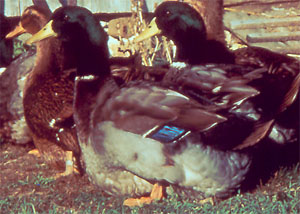
Rouens come in two distinct shapes. The Standard Rouen is a massive duck that reaches weights of between 8 and 10 pounds. It has a horizontal carriage, a large, blocky body with a deep, level keel, and its back arches from shoulders to tail. The head is round with a medium size bill that is concave along the top line. The production Rouen averages two pounds less than the Standard Rouen and has a trimmer body and more upright carriage (Holderread, 84). The Rouen drake has a dark yellow bill, bright orange shanks and feet, and black eyes. His head, upper neck, and tail are dark green, lower neck and breast are dark brown, upper back is dark gray, and lower body light gray. A white band encircles his neck and a diagonal white/blue/white line crosses his wings. A Rouen duck has a brown bill, dark orange shanks and feet, and black eyes. She also has the diagonal white/blue/white color pattern on her wings but the rest of her plumage is brown with black texturing. (Malone et. al., 309) Recently, breeders have also developed and exhibited Black, Blue, Fawn, and Pastel varieties. (Holderread, 84)
Rouens are docile birds that are valued for their meat. They are poor layers, producing only 35-125 eggs yearly, but they make fine roasting ducks and have abundant, delicately flavored flesh. This unsurpassed gourmet quality comes at a price, though, as Rouen ducks are slow to mature. While this slow maturation (6-8 months) makes them impractical for commercial meat production, Rouens are suitable for the home or small farm. (Batty, 124)
“When choosing Rouen breeders, emphasis should be placed on vigor, strong legs, large size, good body length, deep keels that are straight and level, horizontal body carriage, and proper color markings.” In Standard Rouens, overly developed keels can cause breeding problems for drakes so it is advised to retain some males for breeding that are not as extreme in size and keel development. Standard ducks are so heavy that they tend to crush their eggs if allowed to incubate them. (Holderread, 85)
ALBC’s 2000 census of domestic waterfowl in North America found 5,043 breeding Rouen ducks. Thirty-one people reported breeding Rouens, and there are 16 primary breeding flocks with 50 or more breeding birds currently in existence. (Bender, 4) Consider this premier meat bird as a tasty, beautiful addition to your flock.
Status: See CPL
Bibliography:
Batty, Dr. J. Domesticated Ducks and
Geese. London, England: Fanciers Suppliers Ltd, 1985.
Bender, Marjorie E. F. D. Phillip Sponenberg, and Donald Bixby. Taking Stock of Waterfowl: The Results of the American Livestock Breeds Conservancy’s Domestic Duck and Goose Census. Pittsboro, NC: The American Livestock Breeds Conservancy, 2000.
Holderread, Dave. Storey’s Guide to Raising Ducks. Pownal, VT: Storey Communications, Inc., 2001.
Malone, Pat; Donnelly, Gerald; and Leonard, Walt. American Standard of Perfection.. Mendon, MA : American Poultry Association, Inc. , 1998.
Click Here for Breed Clubs and Association Contacts
| The American Livestock Breeds Conservancy | |
PO Box 477 |
ALBC is a trademark
of American Livestock Breeds Conservancy. |
Pittsboro, North Carolina 27312 USA |
|
Telephone: 919-542-5704 |
|
Fax: 919-545-0022 |
|
|
HOME About
ALBC Breed Information Calendar ALBC
Store |
|