"...when the last individual
of a race of living things breathes no more, another Heaven and another
Earth must pass before such a one can be again."
-William Beebe
 • SEARCH ALBC
Runner Duck
 Runners
have a long history as evidenced by ancient Javan temple carvings indicating
that Runner-type ducks existed in Indo China 2000 years ago. (Holderread,
47). People in this area of the world have been herding ducks for hundreds
of years. Flocks of ducks, trained to stay in sight of a herder’s long
bamboo pole with cloth strips attached to one end, were driven out to
rice paddies and fields during the day to glean scattered grain, weed
seeds, snails, insects, larvae, small reptiles and the like. The herder
then drove the flock home at night and kept it in a protective bamboo
or clay enclosure. In the morning, eggs were gathered and the herder then
set off again with his ducks for another day’s foraging. Over many centuries,
these conditions selected ducks that were good walkers, excellent foragers,
and prolific layers. It was this specially adapted bird, tradition has
it, that was introduced into the United Kingdom from Malaya by a ship’s
captain around 1850. Their high egg production and unique appeance caused
Runners to become widely popular. (Holderread, 48)
Runners
have a long history as evidenced by ancient Javan temple carvings indicating
that Runner-type ducks existed in Indo China 2000 years ago. (Holderread,
47). People in this area of the world have been herding ducks for hundreds
of years. Flocks of ducks, trained to stay in sight of a herder’s long
bamboo pole with cloth strips attached to one end, were driven out to
rice paddies and fields during the day to glean scattered grain, weed
seeds, snails, insects, larvae, small reptiles and the like. The herder
then drove the flock home at night and kept it in a protective bamboo
or clay enclosure. In the morning, eggs were gathered and the herder then
set off again with his ducks for another day’s foraging. Over many centuries,
these conditions selected ducks that were good walkers, excellent foragers,
and prolific layers. It was this specially adapted bird, tradition has
it, that was introduced into the United Kingdom from Malaya by a ship’s
captain around 1850. Their high egg production and unique appeance caused
Runners to become widely popular. (Holderread, 48)
 The
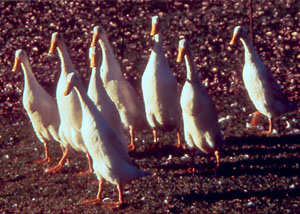
Runner, also known as “Indian RunnerÓ, weighs between 4 and 4 1/2 pounds.
This breed’s slim body and long neck has prompted the description of a
“wine-bottle with a head and legs.Ó Its head is slender with eyes set
high, the bill is straight, and the legs are set far back on their bodies,
resulting in the upright carriage characteristic of the breed. Typical
carriages are 45Õ to 75Õ above the horizontal, but when agitated, some
runners stand perpendicular to the ground. (Holderread, 49) There are
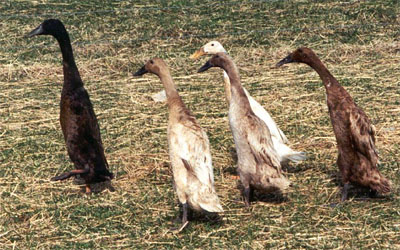
more color types of Runner ducks than any other breed of duck. Varieties
recognized in the American Standard of Perfection are: Fawn & White, White,
Penciled, Black, Buff, Chocolate, Cumberland Blue, and Gray. Nonstandard
varieties include Fairy Fawn, Blue Fairy Fawn, Golden, Saxony, Blue Fawn,
Pastel, Trout, Dusky, Khaki, Cinnamon, Silver, Lavender, Lilac, Blue-Brown
Penciled, Blue-Fawn Penciled, Emery Penciled, Porcelain Penciled, and
Splashed. (Malone et. al., 314-15) Breeders continue to develop new varieties.
The
Runner, also known as “Indian RunnerÓ, weighs between 4 and 4 1/2 pounds.
This breed’s slim body and long neck has prompted the description of a
“wine-bottle with a head and legs.Ó Its head is slender with eyes set
high, the bill is straight, and the legs are set far back on their bodies,
resulting in the upright carriage characteristic of the breed. Typical
carriages are 45Õ to 75Õ above the horizontal, but when agitated, some
runners stand perpendicular to the ground. (Holderread, 49) There are
more color types of Runner ducks than any other breed of duck. Varieties
recognized in the American Standard of Perfection are: Fawn & White, White,
Penciled, Black, Buff, Chocolate, Cumberland Blue, and Gray. Nonstandard
varieties include Fairy Fawn, Blue Fairy Fawn, Golden, Saxony, Blue Fawn,
Pastel, Trout, Dusky, Khaki, Cinnamon, Silver, Lavender, Lilac, Blue-Brown
Penciled, Blue-Fawn Penciled, Emery Penciled, Porcelain Penciled, and
Splashed. (Malone et. al., 314-15) Breeders continue to develop new varieties.
Runner ducks are prolific layers and good strains will lay well in excess of 200 white, hen-sized eggs per year. (Batty, 91) The most active forager of all breeds, they will cover a large area in search of snails, slugs, insects, and other edibles. Their active disposition is evident right from the start, reports breeder David Holderread. When taking hatched ducklings from the incubator he must move slowly and talk to them quietly to keep them from jumping overboard in their enthusiasm to explore their new world. (Holderread, 51) While not capable of sustained flight, Runners can scramble over a two to three foot enclosure for food. Because this duck is small it is not valued primarily as meat bird, but many regard Runners as having a flavor similar to a wild duck. (Batty, 91)
When choosing breeders, “avoid ducks that have low body station, short stocky bodies with prominent shoulders and chests; round heads with prominent foreheads; short bills and/or concave at the top line; and tails that are constantly cocked upward, even when the bird is excited.Ó Look for strong legs and a smooth running gait and choose birds that come from families with a history of good laying and foraging ability. (Holderread, 50)
ALBC’s 2000 census of domestic waterfowl in North America found 2,916 breeding Runner ducks. Twenty-six people reported breeding Runners, and there are 12 primary breeding flocks with 50 or more breeding birds currently in existence. (Bender 4) Runners make excellent show birds and are entertaining pets, wonderful pest controllers and fine layers. Consider this breed as an addition to your flock.
Status: See CPL
Bibliography:
Batty, J. Domesticated Ducks and Geese.
Liss, England: Nimrod Book Services, 1985.
Bender, Marjorie E. F. D. Phillip Sponenberg, and Donald Bixby. Taking Stock of Waterfowl: The Results of the American Livestock Breeds Conservancy’s Domestic Duck and Goose Census. Pittsboro, NC: The American Livestock Breeds Conservancy, 2000.
Holderread, Dave. Storey’s Guide to Raising Ducks. Pownal, VT: Storey Communications, Inc., 2001.
Malone, Pat; Donnelly, Gerald; Leonard, Walt. The American Standard of Perfection. Mendon, MA: The American Poultry Association, Inc. 1998.
| The American Livestock Breeds Conservancy | |
PO Box 477 |
ALBC is a trademark
of American Livestock Breeds Conservancy. |
Pittsboro, North Carolina 27312 USA |
|
Telephone: 919-542-5704 |
|
Fax: 919-545-0022 |
|
|
HOME About
ALBC Breed Information Calendar ALBC
Store |
|