"...when the last individual
of a race of living things breathes no more, another Heaven and another
Earth must pass before such a one can be again."
-William Beebe
 • SEARCH ALBC
Dartmoor Horse
 The
Dartmoor descends from the native ponies present for many centuries on
Dartmoor in southwestern England. Ponies were used for riding, agricultural
work, and pulling skips in coal and tin mines. It was customary to range
the ponies on the moor when they were not needed, and natural selection
helped shape a breed that could thrive on rough terrain and poor forage.
This breed is one of five native, regionally-adapted English ponies; the
others are the Dales, the Exmoor, the Fell, and the New Forest.
The
Dartmoor descends from the native ponies present for many centuries on
Dartmoor in southwestern England. Ponies were used for riding, agricultural
work, and pulling skips in coal and tin mines. It was customary to range
the ponies on the moor when they were not needed, and natural selection
helped shape a breed that could thrive on rough terrain and poor forage.
This breed is one of five native, regionally-adapted English ponies; the
others are the Dales, the Exmoor, the Fell, and the New Forest.
Dartmoor ponies nearly disappeared during the first half of the 1900s. Mechanization eliminated the need for working ponies, and purebreds were crossed for the production of polo ponies and other sport horses. The formation of the Dartmoor Pony Society in the 1930s was a first step in the Dartmoor’s survival, although the breed did not begin to increase until after World War II. One of the Society’s goals today is the reestablishment of purebred free roaming herds on Dartmoor to replace the mixed breed ponies present now.
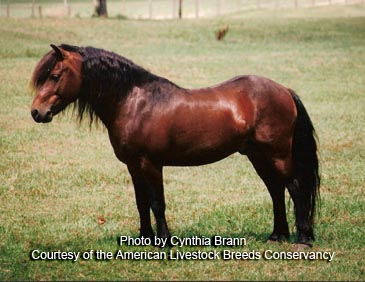
Dartmoor ponies average 12 hands (48") at the withers. Bay and brown are the most -common colors, but black, chestnut, and gray are also found. White markings are uncommon. The head is small with a broad forehead and small ears. The neck is strong and the quarters are well muscled. The legs have dense, flat bone, and the hooves are durable. Manes and tails are full. The sloping shoulder and long stride give a smooth ride. The ponies’ calm, friendly, and willing dispositions make them popular as children’s mounts. The breed’s consistency of appearance makes it easy to pick Dartmoors out of a crowd and to match ponies for driving teams.
The Dartmoor breed has an estimated -global population of 2-3,000. About
200 Dartmoor ponies are found in the United States, descending from imports
made during the 1930s, 1940s and 1950s. The registry of the Dartmoor Pony
Society of America was begun in 1936. Demand for Dartmoors exceeds the
supply, but the increasing numbers of ponies will gradually make it possible
for more people to become involved with this versatile and charming breed.
Status: See CPL
| The American Livestock Breeds Conservancy | |
PO Box 477 |
ALBC is a trademark
of American Livestock Breeds Conservancy. |
Pittsboro, North Carolina 27312 USA |
|
Telephone: 919-542-5704 |
|
Fax: 919-545-0022 |
|
|
HOME About
ALBC Breed Information Calendar ALBC
Store |
|