"...when the last individual
of a race of living things breathes no more, another Heaven and another
Earth must pass before such a one can be again."
-William Beebe
 • SEARCH ALBC
American Mammoth Jackstock
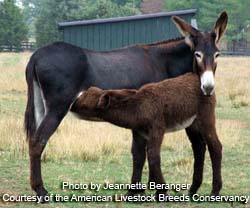 This
American Mammoth Jackstock was developed beginning in the earliest days
of the United States, and it has been an integral part of American agricultural
history. George Washington was one of the leading agricultural innovators
of his day. Among his many interests was the improvement of livestock,
-including the development of an American ass breed that could be used
to produce strong work mules. Washington, with Henry Clay and others,
obtained by gift and purchase a small number of jacks and jennies of the
finest European breeds in the late 1700s and early 1800s. Interest increased
quickly; Washington was offering his jacks for stud service by 1788. The
Catalonian ass from Spain was of primary interest to American breeders,
but the Andalusian (from Spain), Maltese (from Malta), Poitou (from France),
Majorcan (from Majorca), and Italian strains were also used. Breeders
blended these strains together, selecting the offspring for size, soundness,
and strength and thus creating the American Mammoth Jackstock breed.
This
American Mammoth Jackstock was developed beginning in the earliest days
of the United States, and it has been an integral part of American agricultural
history. George Washington was one of the leading agricultural innovators
of his day. Among his many interests was the improvement of livestock,
-including the development of an American ass breed that could be used
to produce strong work mules. Washington, with Henry Clay and others,
obtained by gift and purchase a small number of jacks and jennies of the
finest European breeds in the late 1700s and early 1800s. Interest increased
quickly; Washington was offering his jacks for stud service by 1788. The
Catalonian ass from Spain was of primary interest to American breeders,
but the Andalusian (from Spain), Maltese (from Malta), Poitou (from France),
Majorcan (from Majorca), and Italian strains were also used. Breeders
blended these strains together, selecting the offspring for size, soundness,
and strength and thus creating the American Mammoth Jackstock breed.
Large breeds of asses were found in Kentucky by 1800. Kentucky, Tennessee, and Missouri became the primary mule-producing states around this time. Between 1830 and 1890, several thousand large asses were imported from Spain and other parts of Europe, broadening the genetic base of the breed. The substantial investment in these imports demonstrates the significance of the mule -industry at that time. A registry was established in 1888, and a second registry in 1908. These merged in 1923 as the Standard Jack and Jennet Registry (SJJR), which continues today under the name of the American Mammoth Jackstock Registry. The population of American Mammoth Jackstock peaked in 1920, with an estimated five million animals in the national herd.
 During the 1950s, in response to the -dramatic decline in the number
of American Mammoth Jackstock, the Standard Jack and Jennet Registry (SJJR)
lowered the breed’s height requirements to 14 hands (56") for
males and 13.2 (54") for females. When the American Donkey and Mule
Society (ADMS) established its registry for American Mammoth Jackstock
in 1967, it -followed the SJJR breed standard. Ironically, in the 1980s,
when breed numbers were again increasing, the SJJR raised its height standard
back to the original criteria. This is the origin of the difference in
breed standards between the two registries. The genetic effect of the
lowering of the height standard is not documented, though it is true that
animals which would not have been tall enough historically have been admitted
into the breed in the past 40 years. Better documentation of today’s
population would be useful in understanding the effect of these policy
changes on the breed’s genetic status and conservation needs.
During the 1950s, in response to the -dramatic decline in the number
of American Mammoth Jackstock, the Standard Jack and Jennet Registry (SJJR)
lowered the breed’s height requirements to 14 hands (56") for
males and 13.2 (54") for females. When the American Donkey and Mule
Society (ADMS) established its registry for American Mammoth Jackstock
in 1967, it -followed the SJJR breed standard. Ironically, in the 1980s,
when breed numbers were again increasing, the SJJR raised its height standard
back to the original criteria. This is the origin of the difference in
breed standards between the two registries. The genetic effect of the
lowering of the height standard is not documented, though it is true that
animals which would not have been tall enough historically have been admitted
into the breed in the past 40 years. Better documentation of today’s
population would be useful in understanding the effect of these policy
changes on the breed’s genetic status and conservation needs.
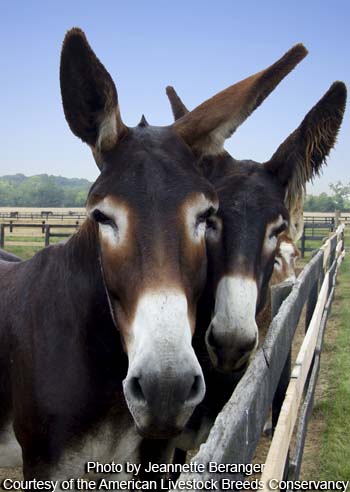
Mammoth Jacks are sturdy and tall, with massive legs and large, well-made heads. The ears are especially long, often measuring 33" from tip to tip. Selection has always been made for size and substance. Traditionally, males were expected to stand at least 14.2 hands (58") high at the withers and females 14 hands (56"). Many animals were taller than this. The weight varied with the height and ranged between 900 and 1,200 pounds. Black used to be considered the only suitable color for the breed, as black Jackstock bred to Percheron mares produced dark colored mules that were easy to match as teams. For the last few decades, however, the market has favored sorrel draft mules, produced by breeding a sorrel Jack and a Belgian mare. As a result, the predominant color of the American Mammoth Jackstock has also become sorrel. With this change in color has come a change in type as well, as the sorrel animals tend to be more coarse in conformation than the blacks.
The primary function of American Mammoth Jackstock has always been to produce draft mules. Today, mules are as likely to be used in recreation as in agricultural work. The market for riding mules is also increasing, but this trend may or may not benefit the American Mammoth Jackstock breed, because Large Standard donkeys, which are lighter boned and more refined, are often used to produce these riding mules. The American Mammoth Jackstock is found in the United States, with a small population in Canada. There are 3-4,000 animals alive today. Only a few hundred of the historic-type black Mammoth Jacks remain, however, and conservation of these strains is a priority for the breed.
Status: See CPL
| The American Livestock Breeds Conservancy | |
PO Box 477 |
ALBC is a trademark
of American Livestock Breeds Conservancy. |
Pittsboro, North Carolina 27312 USA |
|
Telephone: 919-542-5704 |
|
Fax: 919-545-0022 |
|
|
HOME About
ALBC Breed Information Calendar ALBC
Store |
|