"...when the last individual
of a race of living things breathes no more, another Heaven and another
Earth must pass before such a one can be again."
-William Beebe
 • SEARCH ALBC
Shire Horse
 The
Shire horse gets its name from the rural "shires," or counties,
in England, where it was traditionally used for agriculture, heavy hauling,
and war. The breed descends from the “Great Horse” of medieval
England, a large, strong mount which could carry a knight and armor weighing
up to 400 pounds with swiftness and agility. These native English horses
were crossed with Flemish stallions in the 1200s and with Dutch Friesians
in the 1500s. From that period on, the region of Lincolnshire was home
to a distinctive large, black horse called the Lincolnshire Black or Heavy
Black.
The
Shire horse gets its name from the rural "shires," or counties,
in England, where it was traditionally used for agriculture, heavy hauling,
and war. The breed descends from the “Great Horse” of medieval
England, a large, strong mount which could carry a knight and armor weighing
up to 400 pounds with swiftness and agility. These native English horses
were crossed with Flemish stallions in the 1200s and with Dutch Friesians
in the 1500s. From that period on, the region of Lincolnshire was home
to a distinctive large, black horse called the Lincolnshire Black or Heavy
Black.
Large horses were used for long distance hauling and heavy transport over rough country roads and uneven cobblestone streets of cities, and the Heavy Black gradually spread across England in the 1700s. Modern Shire type was established about 1790 based on work done by pioneering livestock breeder Robert Bakewell, also known for his work on Leicester Longwool sheep and English Longhorn cattle. Further standardization was undertaken in the late 1800s, with the formation of a breed society in 1878 and the christening of the breed name Shire in 1884.
The Shire peaked in popularity between 1880 and World War I, but its population plummeted with the mechanization of agriculture and transportation after World War II. The breed declined to its lowest point in the early 1960s, but its fortunes have improved considerably since then. Like the Clydesdale, the Shire has benefited from its use in promotional hitches, especially those advertising breweries. The Whitbread’s hitch of gray Shires, for example, is as well known in England as the Budweiser Clydesdale hitch is in the United States.
Shires were first imported to the United States in the mid-1800s, and the American Shire Horse Association was founded in 1885. The registry has operated continuously except for 1955-1961, when most activity ceased and the breed almost became extinct in the United States. The Shire then experienced a slow revival and today it is more numerous than it has been in many decades, both globally and in the United States.
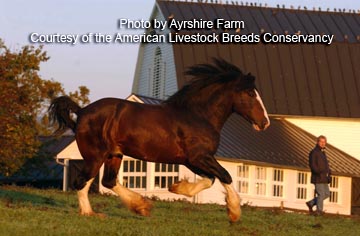
Shires average 17.2 hands (70") at the withers, sometimes reaching
19.2 (76"), with a weight of greater than 2,000 pounds. Bay, black,
brown, and gray are the most common colors in the breed. The head has
a convex profile with a broad forehead and long ears. The neck is long
and well arched, with a long shoulder. The legs are short and feathered
below the knees and hocks. The overall impression of the Shire is one
of substance and power.
Status: See CPL
Click Here for Breed Clubs and Association Contacts
| The American Livestock Breeds Conservancy | |
PO Box 477 |
ALBC is a trademark
of American Livestock Breeds Conservancy. |
Pittsboro, North Carolina 27312 USA |
|
Telephone: 919-542-5704 |
|
Fax: 919-545-0022 |
|
|
HOME About
ALBC Breed Information Calendar ALBC
Store |
|