"...when the last individual
of a race of living things breathes no more, another Heaven and another
Earth must pass before such a one can be again."
-William Beebe
 • SEARCH ALBC
Slate Turkey
 While
most early texts state that the Slate turkey originated from a cross of
the Black turkey on a white turkey, there is little genetic evidence to
support such a conclusion. The slate gene is a legitimate mutation that
arose just as the gene for blue in the Andalusian chicken is the result
of an unrecorded mutation. One added element of confusion in defining
the variety is that there are actually two different genetic mutations
(one dominant and one recessive) that produce the blue slate color, and
these produce slightly different shades. White and rusty brown markings
my be present but are considered a defect.
While
most early texts state that the Slate turkey originated from a cross of
the Black turkey on a white turkey, there is little genetic evidence to
support such a conclusion. The slate gene is a legitimate mutation that
arose just as the gene for blue in the Andalusian chicken is the result
of an unrecorded mutation. One added element of confusion in defining
the variety is that there are actually two different genetic mutations
(one dominant and one recessive) that produce the blue slate color, and
these produce slightly different shades. White and rusty brown markings
my be present but are considered a defect.
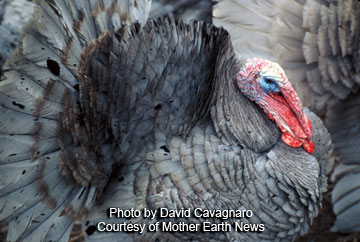
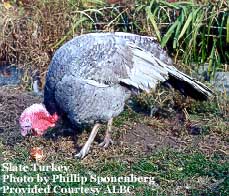 The
Slate or Blue Slate variety is named for its color, which is solid to
ashy blue over the entire body, with or without a few black flecks. It
is also called the Blue or Lavender turkey. Hens are lighter in hue than
the toms. The head, throat, and wattles are red to bluish white. The beak
is horn in color; the eyes are brown; and the beard is black. The shanks
and toes are pink. The Standard weight for a young tom is 23 pounds and
14 pounds for a young hen. Since, however, the Slate has not been selected
for production attributes, including weight gain, for years, many birds
may be smaller than the standard. Careful selection for good health, ability
to mate naturally, and production attributes will return this variety
to its former stature.
The
Slate or Blue Slate variety is named for its color, which is solid to
ashy blue over the entire body, with or without a few black flecks. It
is also called the Blue or Lavender turkey. Hens are lighter in hue than
the toms. The head, throat, and wattles are red to bluish white. The beak
is horn in color; the eyes are brown; and the beard is black. The shanks
and toes are pink. The Standard weight for a young tom is 23 pounds and
14 pounds for a young hen. Since, however, the Slate has not been selected
for production attributes, including weight gain, for years, many birds
may be smaller than the standard. Careful selection for good health, ability
to mate naturally, and production attributes will return this variety
to its former stature.
The Slate was accepted by the American Poultry Association in 1874. It has been popular in exhibition circles and is gaining popularity in pastured poultry production. Renewed interest in the biological fitness, survivability, and superior flavor of the Slate has captured consumer interest and created a growing market niche. The Slate is less well documented and more variable in type and color than any other variety. This makes it more challenging to breed consistently than the others. Its production potential today is not known.
Status: See CPL
Click Here for Breed Clubs and Association Contacts
| The American Livestock Breeds Conservancy | |
PO Box 477 |
ALBC is a trademark
of American Livestock Breeds Conservancy. |
Pittsboro, North Carolina 27312 USA |
|
Telephone: 919-542-5704 |
|
Fax: 919-545-0022 |
|
|
HOME About
ALBC Breed Information Calendar ALBC
Store |
|