"...when the last individual
of a race of living things breathes no more, another Heaven and another
Earth must pass before such a one can be again."
-William Beebe
 • SEARCH ALBC
This article appeared in the March/April issue of the ALBC newsletter. ALBC members receive 6 bi-monthly newsletters that contain articles about the breeds of livestock and poultry that we work to conserve as well as the people involved in these efforts. Members also receive an annual breeders directory that provides contact information for ALBC members who have breeding stock available, as well a list of products from these breeds that they offer for sale.
Please support our work, join today!
From the March/April 2009 ALBC Newsletter:
Changes to the 2009 Conservation Priority List
ALBC has completed its annual review of its Conservation Priority List (CPL), leading to several changes for the 2009 version.
The Chirikof Island cattle have been added to the Study category. This feral breed lives on a climactically harsh Pacific island about 60 miles southwest of Alaska’s Kodiak Island. DNA evidence of this feral population suggests that it is genetically unique.
(See article to right)
The Mytotonic or Tennessee Fainting goat has moved from Threatened to Watch. Annual registration numbers are reaching 2500. It’s exciting to watch this breed grow in popularity and utility.
The Leicester Longwool sheep is not enjoying the same success, and is moving from Threatened to Critical. The populations in the U.S. and other countries are declining, including in its home country of England, making the U.S. population all the more important to the long-term survival of the breed.
The Florida Cracker sheep has been added to the Study category. Breeders of these sheep note differences between them and the Gulf Coast Sheep, with which they have previously been grouped. Ongoing studies will hopefully validate the situation with this genetic resource.
The Saddleback pig has returned to the CPL and has been placed in the Study category. In 2006, it had been removed from the CPL because ALBC felt the U.S. population was not able to effectively participate in the global conservation of the breed. Information has recently come to light that some of the Saddleback pigs in the U.S. could be Wessex pigs, which are extinct in England, their country of origin. Other pigs are from a later importation and are known to be British Saddleback pigs, a composite of the Essex and Wessex pigs. Documentation of these pigs will be needed to determine their status on the CPL.
The American Mammoth Jackstock has been moved from Threatened to Critical. Adjusting for duplication with the American Donkey Registry and the American Mammoth Jackstock Registry, annual registrations are approximately 400. Both organizations agree this represents only a portion of the population and many animals remain unregistered. Registration numbers place the breed in the Threatened category; however, the global population of this American breed is estimated to be fewer than 2000, placing it in the Critical category. In this instance, ALBC is giving priority to the global population and listing the American Mammoth Jackstock as Critical.
The Irish Draught horse (IDH) has been moved from Study to Watch. There are approximately 200 IDH’s in the 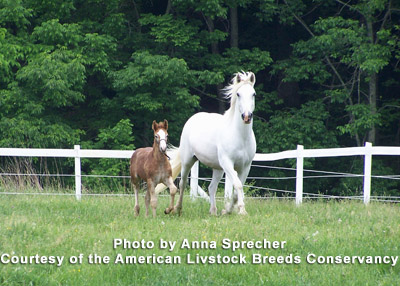 U.S., and an estimated 6000 – 7000 in the global herd. There are many complicated human issues associated with this breed, including a divergence from historic breed type in Ireland, constraining and inconsistent inspection practices, historic incentives for crossbreeding purebred mares to create the more sought after performance horse, and orphaned international populations. Look for more information on this breed in future newsletters.
The Shire horse has moved from Watch to Critical as populations have declined. Registrations recorded by the American Shire Horse Association were 169 in 2007. In the same year, the English studbook recorded 471 (267 mares and 204 stallions). Australia reports only 180 Shires on the continent. For conservation to be successful, animals must have useful work. Draft animals face particular difficulties, as there is no road back from the internal combustion engine.
The Santa Cruz horse has been added as a strain of the Colonial Spanish horse in the Critical category. The population totals 32. These horses were brought from Mexico in the mid-1800s for ranch work on the Island of Santa Cruz. For more information on this strain, see the article in the January-February 2009 issue (misidentified as Nov-Dec 2008) of the ALBC News.
The Java chicken is moving from Critical to Threatened following an ALBC census of the breed. There are 835 breeding birds and 4 primary breeding flocks. This is a real accomplishment for a breed that in 2002 numbered only 112.
Every year, ALBC requests registration information from breed associations. If you have information on breeds that is more current than indicated by the status of the breed on the CPL, we’d love to hear from you. Call or drop us an email anytime. Thank you for your part in saving these breeds for future generations and the useful work they are destined to do.
| The American Livestock Breeds Conservancy | |
PO Box 477 |
ALBC is a trademark
of American Livestock Breeds Conservancy. |
Pittsboro, North Carolina 27312 USA |
|
Telephone: 919-542-5704 |
|
Fax: 919-545-0022 |
|
|
HOME About
ALBC Breed Information Calendar ALBC
Store |
|