"...when the last individual
of a race of living things breathes no more, another Heaven and another
Earth must pass before such a one can be again."
-William Beebe
 • SEARCH ALBC
Culling- Sometimes Difficult, Always Necessary
By Elaine Shirley
While this article is geared toward sheep, it is a reminder to all breed stewards that culling is an essential part of breed stewardship.
In the 18th century, Robert Bakewell developed the Leicester Longwool breed through strict selection for desired 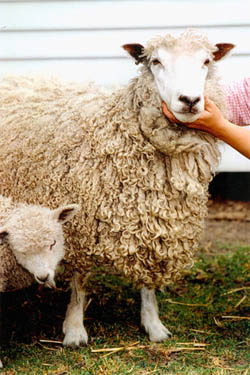 characteristics. His success was a result of heavy culling – removing undesirable animals from the breeding group. Bakewell was selecting for an animal that matured more rapidly than the average sheep and he desired “two pounds of meat where there had only been one before.”
Over the 19th and 20th centuries, the Leicester Longwool was selected to be the wool-oriented animal that we know today. Although the focus of the breed has changed, the need for culling has not. As stewards of Leicester Longwools and many other wonderful, historic breeds, breeders must always consider whether the animals they are breeding will help or hurt the overall breed population. Here are some things to keep in mind when evaluating your flocks and herds for potential breeding animals.
- Culling is, sometimes, a difficult choice.
The ram that butts you is a lot easier to get rid of than a friendly ewe, but they both must be examined with a critical eye. The ram that butts you in any season other than fall (when his hormones get the best of him), or one that is very aggressive at any time of the year should go to the butcher or the stockyards. You are not raising sheep, or any animals, to get hurt! In the worst case scenario, rams, bulls, and other aggressive animals can kill, and over the years there have been cases of this happening. Never, at any time of the year, trust a ram, even if it is Mr. Sweetie; they ALL have the potential to butt. When butted by a ram, I will grab him under the chin and give him a loud lecture on who is in charge. Ninety percent of the time the scolding works and the ram does not try his luck again. You must remember that you are the top animal in your flock or herd and each animal must know this. If a tongue lashing does not work, get rid of the animal. I have been very pleased how well-behaved Leicester rams are in general, but mean ones do crop up. Get them out of the gene pool.
A ewe that needs to be culled can be sold for meat, kept where she will not reproduce, or sold to someone who is interested in a pet or her fleece. Do not transfer registration papers to the new owners. If she had something that made you cull her, do not let her potentially produce animals that could be registered. 
- Males should be culled more heavily than females.
Remember the old saying “the ram is fifty percent of the flock”? One ram can spread his genetic influence very quickly because he can produce so many more offspring in his life when compared to a female. Choose your ram(s) carefully and be very critical of your ram lambs. I usually castrate about 1/3 of the ram lambs in the first few days of life. When I notice ram lambs with spots, ones whose mothers were not ideal, or ones with obvious problems, I do not hesitate to castrate. Again in the fall or winter of their first year, I cull another 1/3 of the ram lambs. Ones that have not grown well, have scurs, have questionable bites, or have poor quality wool are separated from the flock. They can be culled by sending them to the stockyards, castration, or selling them for meat. Sometimes I will keep wethers (castrated males) around and let them make a career of wool-making. It is important for you to find a “job” for any non-breeding animals or they will cost you time and money without contributing to the farm. I typically end up with 1/3 of my ram lambs as potential breeders. I continue to evaluate them as they develop and I am not opposed to culling at any point in time. The moral of the story is to manage the males. Select your breeding males very carefully.
- Feet and teeth are very important.
When I started taking care of the Leicester Longwool sheep at Colonial Williamsburg, I asked Jack Price from Maryland for advice. He raised sheep for many years and was a “no nonsense” shepherd. He said, “If their feet or their teeth are not any good, get rid of them. They need their teeth to eat and they need their feet to get them to their food”. I have followed this advice for many years and it makes a lot of sense for any breed. If an animal has poor feet, it will influence their foraging abilities, their overall health, and more. If an animal has a poor mouth, it can influence a world of other things. Check the bites of all your sheep – underbites and overbites are very serious. In fact, these flaws are unacceptable in rams and are very bad trait to have in ewes (depending on the severity of the problem). Bad feet should be looked at the same way. Sheep who have bad pasterns should be culled. Sometimes an older sheep may start to go down in their pasterns because of age; however, ALL young animals should have quality feet.
- There are some traits that are non-negotiable and are always cullable offenses.
For each species, there are certain traits that are absolutely unacceptable. As you work with certain species and specific breeds, you will learn what traits are cullable offenses. It is important to educate yourself about these non-negotiable traits by networking with other breeders, knowing the breed standard, asking questions, and consulting others when in doubt. This will be especially important if you are new to a specific breed or species. For sheep, rams with testicle problems are automatically removed from the breeding population — including rams with one testicle, undescended testicles, very small testicles, and testicles that are incorrectly shaped. As mentioned above, sheep with poor bites and poor feet are also removed from the gene pool.
Another cullable offense is any sheep with structural problems such as a back that is not straight or hips/legs that do not work well. Ewes who have prolapsed and their sons should be removed from the breeding flock.
- Read and use the breed standard
The breed standard was written to give you a guideline as to what makes your breed different from other breeds. Make sure your animals adhere to the breed standard and the unique characteristics that are part of our breed. For the Leicester Longwool, it is important to look at the wool. There is a fairly wide range of strong and fine wool that is acceptable according to the standard, but you can get wool that is too strong and wool that is too fine. Breeders need to keep this range available and not breed exclusively for fine wool. When in doubt, go to the standard.
- Don’t feel guilty about culling, you should feel guilty if you do not cull.
These breeds are here to do a job and to create the next generation. Ideally the next generation will be better than the last. You feed your animals, medicate them, and keep them safe. Their part of the bargain is to produce good quality offspring, and your decisions help ensure that quality offspring are possible. Remember you are a breed steward and there were people before you who culled to give us the breeds we have today. You owe it to the next generation of breeders to do the same. Sometimes it is hard to cull, but it is always necessary.
Elaine Shirley is the manager of Colonial Williamsburg’s rare breeds program. As such, she works with many breeds including Leicester Longwool sheep, Milking Devon cattle, and Nankin chickens. Shirley was the 2009 recipient of the Bixby-Sponenberg Conservation Award, has been a member of ALBC since 1987, and has served on the ALBC Board of Directors. She can be contacted at, Colonial Williamsburg Foundation, Coach and Livestock Department, Elaine Shirley, PO Box 1776, Williamsburg, VA, 23187-1776, (757) 220-7790, [email protected].
| The American Livestock Breeds Conservancy | |
PO Box 477 |
ALBC is a trademark
of American Livestock Breeds Conservancy. |
Pittsboro, North Carolina 27312 USA |
|
Telephone: 919-542-5704 |
|
Fax: 919-545-0022 |
|
|
HOME About
ALBC Breed Information Calendar ALBC
Store |
|